
How CRM Solutions Drive Business Growth in 2025 and Beyond
The Evolution of CRM: From Contact Databases to AI-Powered Platforms
In today’s competitive business landscape, companies constantly seek tools and strategies to streamline operations, improve customer relationships, and drive revenue growth. One such pivotal tool is the Customer Relationship Management (CRM) system. According to Grand View Research, the global CRM market size was valued at $73.4 billion in 2024 and is expected to grow at a CAGR of 14.6% from 2025 to 2030, underscoring its importance and rapid adoption.
Key Benefits of a CRM for Business Growth
But CRMs today are far more than digital address books. Modern platforms offer powerful features—from AI-driven analytics to seamless integrations—that automate processes, personalize customer engagement, and deliver data-driven insights. When these features are used to their full potential, businesses experience significant revenue growth and increased operational efficiency.
This article will explore key CRM features that can transform your business—covering data management, sales pipeline automation, reporting, and more. We’ll also highlight how platforms like HubSpot, Salesforce, Zoho, and Pipedrive are leading the way in enabling growth and efficiency.
What Is a CRM? The Role of Customer Relationship Management in Business Success
A Customer Relationship Management (CRM) system is software designed to centralize and streamline interactions with current and potential customers. By consolidating customer data, automating routine tasks, and providing valuable insights, a CRM becomes a strategic asset for businesses of all sizes and across various industries (e.g., e-commerce, real estate, healthcare).
- Historical Evolution: CRMs have evolved from basic contact databases to AI-driven platforms capable of predictive analytics and advanced automation.
- Key Benefits:
- More effective lead management
- Improved marketing outcomes through segmentation
- Enhanced customer service via integrated support tools
Whether you’re a small business managing your first lead funnel or a global enterprise streamlining complex workflows, the right CRM features can turn stagnant growth into scalable success.
Data Management: Ensuring Accuracy, Compliance, and Efficiency
Why It Matters
Accurate and clean data is the foundation of any successful business strategy. Conversely, poor data quality can lead to misguided decisions, ineffective marketing campaigns, and lost sales opportunities.
Key Features
- Duplicate Detection & Removal: CRMs like Salesforce and HubSpot automatically identify and merge duplicate entries, keeping your database clean and reliable.
- Data Validation Rules: Platforms such as Zoho CRM enforce validation protocols to prevent incorrect or incomplete data entry.
- Data Enrichment Tools: Integrations with tools like Clearbit auto-populate customer profiles with up-to-date data (e.g., company size, social profiles).
Real-World Example: HexaHealth’s Success with Zoho CRM Plus
HexaHealth, a healthcare platform founded in 2021, struggled with lead leakages and confusion among sales reps when using static spreadsheets. After implementing Zoho CRM Plus with robust customization and workflow automation, they began capturing leads from multiple sources in real-time. Integrating telephony (Knowlarity) and setting up automated triggers, HexaHealth decreased average lead response time by 80%, enabling faster follow-ups and a more targeted approach to patient engagement.
Business Impact
High-quality data enables informed decision-making, personalized experiences, and regulatory compliance (GDPR, CCPA). The end result? Better resource allocation and more meaningful interactions with prospects and customers.
Sales Pipeline Automation: Closing More Deals, Faster
Why It Matters
A well-defined sales pipeline provides visibility into every stage of the sales process. Without it, teams risk losing track of leads, duplicating efforts, or missing high-potential deals.
Key Features
- Deal Pipelines: CRMs like Pipedrive and HubSpot Sales Hub offer visual pipelines, making it easy to track opportunities from initial contact to close.
- Lead Scoring: Platforms such as Salesforce and Zoho CRM use rules-based or AI-driven scoring to prioritize leads most likely to convert.
Industry Insight:
According to Salesgenie, companies with well-managed pipelines see up to 28% higher revenue growth than those without defined processes.
Business Impact
Streamlined sales processes lead to shorter sales cycles, higher conversion rates, and more accurate revenue forecasting. This directly translates into greater operational efficiency and scalable growth.
Marketing Automation: Scaling Personalized Campaigns with Ease
Why It Matters
Marketing automation allows businesses to scale outreach without exponentially increasing the marketing workload. By automating repetitive tasks, marketing teams can focus on strategy and creativity.
Key Features
- Email Automation: Platforms like HubSpot Marketing Hub or ActiveCampaign empower businesses to build automated drip campaigns for consistent lead nurturing.
- List Segmentation: CRMs such as Zoho CRM or Keap help marketers create segments based on behavior, demographics, or engagement level, enabling hyper-personalized messaging.
ROI Stat
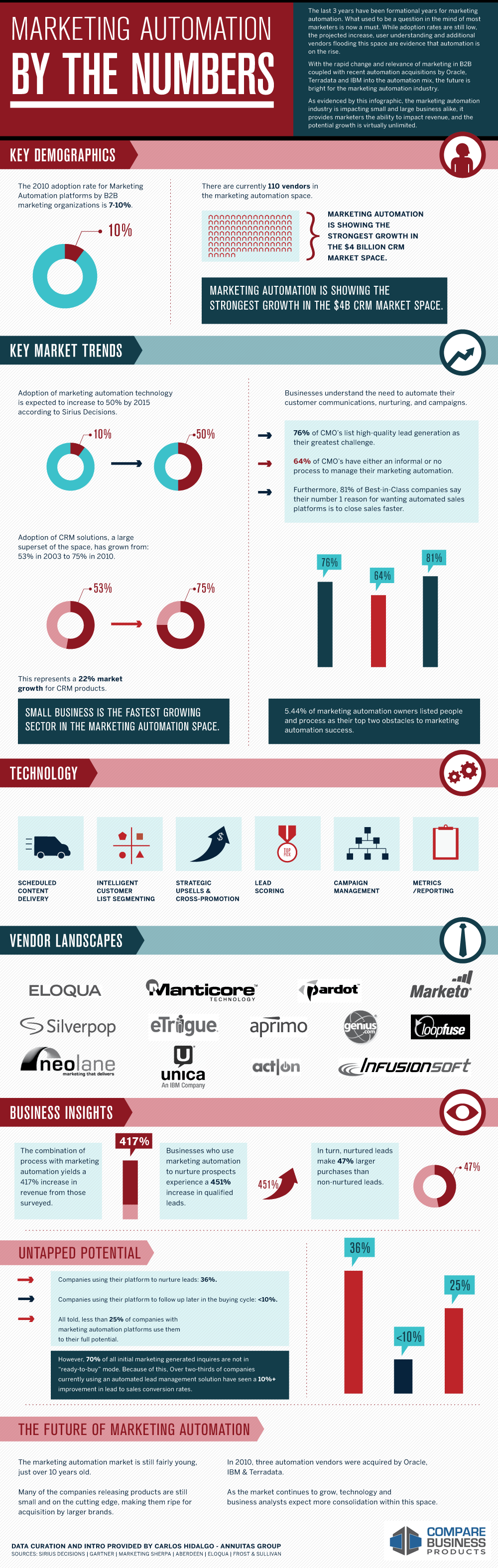
The Annuitas Group found that businesses implementing marketing automation see a 451% increase in qualified leads—a testament to how impactful these tools can be.
Business Impact
Automated campaigns typically yield higher engagement and improved lead quality, boosting marketing ROI. Sending the right message to the right person at the right time ultimately drives repeat business and brand loyalty.
Advanced Reporting and Analytics: Making Data-Driven Decisions
Why It Matters
In a data-driven marketplace, intuition is not enough. CRMs provide analytics and reports that help track performance, identify opportunities, and optimize sales, marketing, and customer support strategies.
Key Features
- Customizable Dashboards: CRMs like HubSpot and Salesforce offer real-time dashboards covering metrics from lead engagement to deal velocity.
- Advanced Reporting Tools: Platforms such as Zoho CRM feature AI-driven insights, forecasting, and in-depth analytics on funnel metrics.
Deep Dive
Predictive analytics are becoming increasingly common in Microsoft Dynamics 365. They help users forecast sales trends and proactively tackle potential bottlenecks.
Business Impact
By leveraging CRM reporting and analytics, companies can pinpoint where to invest resources, refine strategies on the go, and measure ROI more accurately. This continuous improvement loop fuels sustained growth.
Customer Support Optimization: Enhancing Retention and Satisfaction
Why It Matters
Excellent customer service is crucial for retention and long-term loyalty. A CRM platform that streamlines support ensures timely issue resolution and a better overall experience.
Key Features
- Service Hubs & Help Desks: Tools like HubSpot Service Hub or Freshdesk centralize support tickets and enable live chat for real-time assistance.
- SLA Management: Zoho Desk or Zendesk helps businesses track and meet service-level agreements, ensuring fast response times.
Real-World Example: Swapfiets Improves Customer Service Efficiency with HubSpot
Swapfiets, a leading “bicycle as a service” company with over 280,000 members across eight countries, needed to streamline customer service operations and resolve support tickets more efficiently. Their previous system, Zendesk, had outdated workflows and lacked a single source of truth, leading to long ticket resolution times—sometimes stretching into months.
After evaluating five different CRM solutions, Swapfiets chose HubSpot’s Service Hub for its scalability, automation, and data insights. Within four months, the company successfully onboarded HubSpot Service Hub, consolidating five tools into one and reducing the maximum response time from months to just one week.
Key Results:
- 40,000 tickets resolved every month with HubSpot’s automation tools
- Improved call routing and customer interactions through the HubSpot–Aircall integration
- Increased retention rates by enabling faster, personalized support with complete customer histories
Marc de Vries, CEO of Swapfiets, highlighted HubSpot’s impact:
“HubSpot’s Service Hub is helping to provide our staff with the right tools to be more proactive and efficient so that our members can enjoy worry-free biking.”
Business Impact
Prompt, organized support cultivates loyal customers, reduces churn, and opens the door to upselling and cross-selling opportunities—boosting overall revenue.
CRM Integrations: Creating a Seamless Business Ecosystem
Why It Matters
Today’s businesses use various tools—email, team chat, e-commerce platforms, accounting software, etc. Integrating these systems with your CRM creates seamless workflows, eliminates data silos, and saves countless hours.
Key Features
- App Integrations: CRMs like Salesforce and HubSpot have expansive marketplaces, allowing connections with Slack, Shopify, QuickBooks, Outlook, and more.
- Real-Time Data Sync: Platforms like Pipedrive ensure up-to-date data across all connected apps, fostering better collaboration.
Business Impact
By integrating multiple systems into one coherent ecosystem, businesses experience reduced manual data entry, fewer errors, and a unified view of each customer journey—driving both efficiency and bottom-line growth.
Real-World Examples of CRM Features Driving Business Growth
Boosting Sales Efficiency with Pipedrive
Real-World Example: Gray Matters Increases Conversion Rates by 33% with Pipedrive
Gray Matters, a UK-based business development consultancy, initially used Google Sheets to manage sales data. However, as the company grew, owner Adam Graham realized that spreadsheets limited their ability to track prospects effectively and spot sales trends. To scale efficiently, they turned to Pipedrive CRM.
By leveraging Pipedrive’s customization features—including Custom Fields and Pipeline Management—Gray Matters gained better insights into its sales process, allowing it to analyze why deals were won or lost. This data-driven approach led to strategic shifts in marketing and even new product development.
Key Results:
10% increase in conversion rate percentage points
Overall conversion rate improved by one-third
30% current conversion rate, up from 20% in just 18 months
According to Adam Graham, Owner of Gray Matters:
“The ability to customize fields has made a big difference in how we report and the data we collect. It’s enabled us to understand our conversion rates to a certain audience and where we might be more successful so we can market differently to those people.”
Today, Gray Matters even recommends Pipedrive to its clients, promoting it as a tool to stick to a structured, long-term sales process rather than relying on gut instincts or irregular tracking.
Scaling Marketing Campaigns with HubSpot
Real-World Example: HR Connect Saves 50% of Time on Marketing & CRM Workflows with HubSpot
HR Connect, a UK-based HR services provider, faced disconnected sales and marketing systems, relying on multiple spreadsheets and outdated tools. With data siloed across different teams, sales reps had no real-time access to customer activity, and marketing struggled to build targeted campaigns efficiently.
Seeking a unified, automated solution, HR Connect implemented HubSpot’s Smart CRM, Marketing Hub, and Sales Hub, fully integrating their customer data, content management, and sales pipeline.
Key Results:
50% reduction in time spent building lists and sending emails
25% faster customer conversions thanks to automated lead tracking and segmentation
Seamless marketing & sales integration, eliminating the need for manual data transfers
Jon Raeside, Marketing Manager at HR Connect, highlighted the impact:
“HubSpot’s Smart CRM halved the time it takes us to build lists and send emails. The drag-and-drop experience is so easy, and we can now track leads through the funnel without manual exports or data inconsistencies.”
Best Practices for Maximizing CRM Potential
To maximize the value of a Customer Relationship Management (CRM) system, businesses need to go beyond just implementation. Optimizing CRM features ensures data accuracy, workflow efficiency, cross-platform integration, and team adoption—all contributing to business growth and customer satisfaction. Here’s how to leverage CRM capabilities effectively for long-term success:
Conduct Regular Data Audits for Accuracy & Compliance
Why It Matters:
Poor data quality leads to ineffective marketing, lost sales opportunities, and compliance risks—businesses with clean, well-maintained CRM data experience higher customer engagement and conversion rates.
Best Practices:
- Schedule automated data cleansing sessions: Use AI-powered deduplication tools like HubSpot’s Data Quality Command Center or Zoho’s Smart Data Cleanup to remove duplicate, incomplete, or outdated records.
- Establish data entry validation rules: Prevent human errors by setting mandatory fields and formatting requirements.
- Monitor compliance with GDPR & CCPA: Ensure data privacy and security by setting role-based permissions and audit logs for tracking changes.
- Review and update customer records quarterly: Keep customer details, preferences, and history up-to-date for personalized interactions and retargeting campaigns.
Customize Your CRM to Fit Business Needs
Why It Matters:
A one-size-fits-all CRM may not align perfectly with your sales, marketing, or customer support processes. Customizing CRM fields, automation rules, and dashboards helps teams work more efficiently.
Best Practices:
- Customize pipelines for different sales cycles: A B2B sales funnel will differ from those for e-commerce, SaaS, or real estate; define stages based on deal progression.
- Automate lead scoring and follow-ups: Set up rules-based or AI-powered lead scoring to prioritize prospects with the highest conversion potential.
- Create custom dashboards: Tailor CRM analytics to track KPIs like conversion rates, average response time, and sales velocity.
- Use role-based UI customization: Different departments (sales, support, finance) should see only the most relevant CRM fields and workflows.
Integrate Your CRM with Key Business Tools
Why It Matters:
Standalone CRMs can create data silos, limiting visibility into the customer journey. Connecting your CRM with essential business tools boosts efficiency, enhances collaboration, and provides a unified customer experience.
Best Practices:
- Sync your CRM with accounting software: Tools like QuickBooks, Xero, or FreshBooks streamline invoicing, payment tracking, and financial reporting.
- Integrate marketing automation tools: Connecting CRMs like HubSpot, Salesforce, or Zoho CRM with platforms like Mailchimp or ActiveCampaign enables automated lead nurturing and customer engagement.
- Connect with communication and productivity apps: CRM integrations with Slack, Microsoft Teams, or Gmail/Outlook ensure smooth collaboration.
- Enable e-commerce & customer support integrations: Syncing with Shopify, Zendesk, or WhatsApp Business enhances real-time customer interactions.
Train Teams to Fully Utilize CRM Features
Why It Matters:
A CRM is only as powerful as its users. Without proper training, teams underutilize features, leading to inefficiencies and low adoption rates.
Best Practices:
- Conduct live training sessions & webinars: Schedule quarterly or biannual training on CRM updates and advanced functionalities.
- Create step-by-step SOPs and video tutorials: Provide an internal knowledge base with guides on CRM workflows, automation, and best practices.
- Encourage role-based learning: To enhance productivity, offer personalized training for sales reps, marketers, and customer support teams.
- Monitor CRM adoption and track engagement: Use CRM usage analytics to identify underutilized features and address training gaps.
Conclusion: Leveraging CRM Features for Sustainable Business Growth
CRM systems can be transformational if their core features—data management, sales pipeline automation, marketing automation, reporting, and integrations—are adequately leveraged. By unifying customer data and automating workflows, CRMs help businesses enhance relationships, optimize processes, and drive consistent revenue growth.
Are you making the most of your CRM? With AI-driven features, advanced data enrichment, and a host of integrations, modern CRMs are your gateway to scalable success in an increasingly competitive market.